
The Quiet Power of Compound Interest

Compound interest rewards time more than amount. Here's why starting early beats saving more — with a side-by-side example — and how to see the curve for yourself.

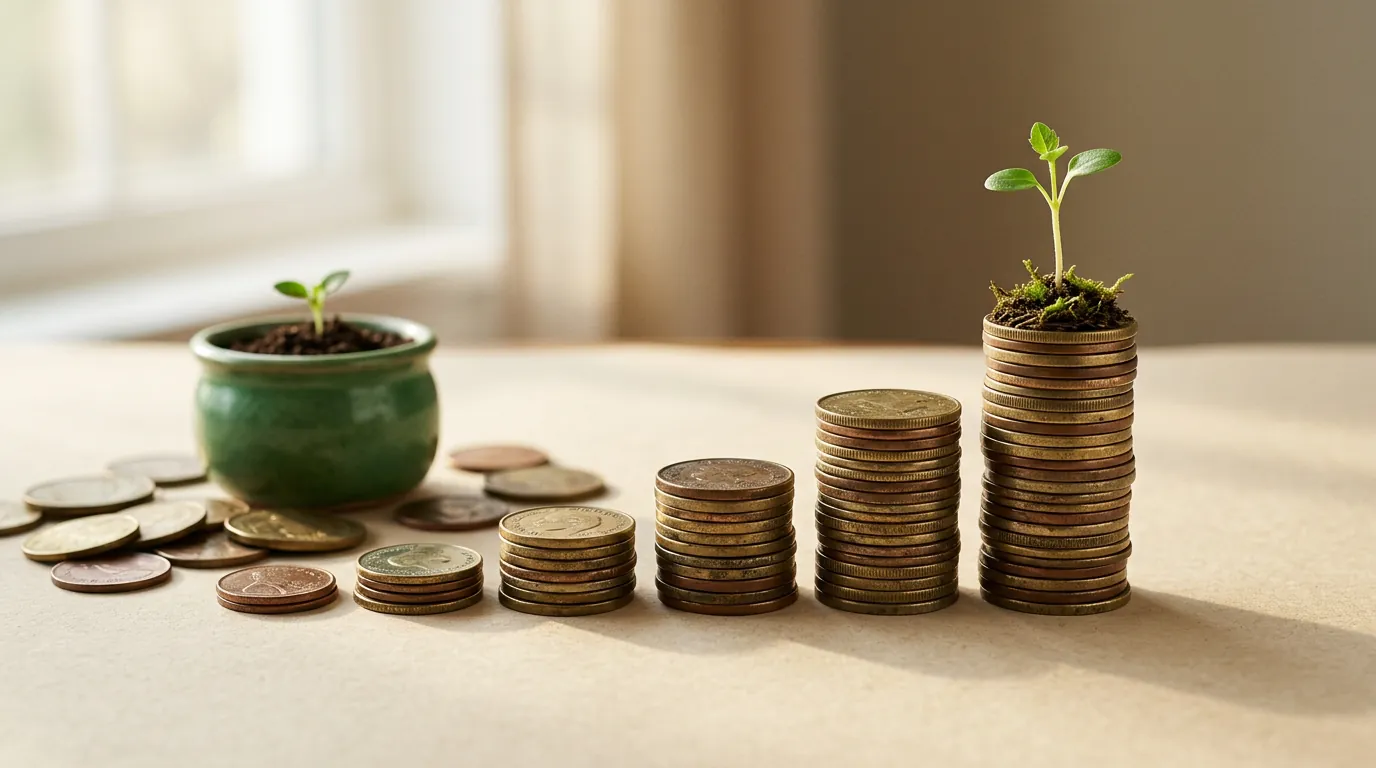
The power of compound interest — rising columns of brass coins with a sprouting green seedling

Albert Einstein probably never called compound interest “the eighth wonder of the world” — but the myth endures because the idea behind it is genuinely astonishing. Money that earns returns, on returns, on returns, grows along a curve our linear intuition badly underestimates. If no one ever showed you this, here it is — and it’s the most hopeful math in personal finance.

Time is the heavy lifter

Consider two savers. Both contribute $250 a month at a 7% annual return — the only difference is when they start:

SaverContributesTotal put inApprox. value at 65
Avaage 25–35, then stops$30,000~$300,000+
Benage 35–65, every month$90,000~$300,000

Ben puts in three times as much money. Yet because Ava’s balance had a decade longer to compound, the two end up remarkably close — and in many scenarios Ava comes out ahead. The lesson is blunt: the most valuable input to compounding is time, not amount.

Why the curve bends

In the early years, almost all of your growth comes from your own contributions. Somewhere around the midpoint, a quiet crossover happens: the interest your balance earns each year exceeds what you contribute. From that point on, your money is doing more work than you are — the future value climbs far faster than your deposits.

The goal of saving is to reach the day your interest out-earns your contributions — and then to keep going.

What to actually do

  1. Start now, even small. A modest amount today beats a large amount later — that’s the whole time-value-of-money idea.
  2. Automate it. Compounding rewards consistency; automation removes willpower from the equation.
  3. Leave it alone. Every withdrawal resets a piece of the curve.

See your own curve

Numbers on a page are easy to nod at and forget. Open the compound savings calculator, enter your starting balance and monthly contribution, and drag the “years” slider. Watch the moment the interest portion overtakes your contributions — that visual changes how people save more than any article can. When you’re ready to put it to work, the saving guide and investing guide show where to start.


Try the calculator Compound Savings Calculator

Frequently asked questions

What is compound interest?

Compound interest is interest earned on both your original money and on the interest it has already earned. Because each year's growth joins the balance that earns the next year's growth, your money grows along an accelerating curve rather than a straight line. It's the core force behind every long-term savings and investing plan.

Why is starting early so important for compound interest?

Because time, not the amount you save, is the biggest input. Someone who invests $250 a month for just 10 years starting at 25 can end up with as much as someone who invests for 30 years starting at 35 — despite contributing a third as much. The early money simply has far longer to compound.

How does compound interest grow over time?

Slowly at first, then dramatically. In the early years almost all your growth comes from your own contributions. Around the midpoint a crossover happens where the annual interest your balance earns exceeds what you add. After that point your money is doing more work than you are, and the curve bends sharply upward.

What's the difference between compound and simple interest?

Simple interest is calculated only on your original principal, so it grows in a straight line. Compound interest is calculated on principal plus accumulated interest, so it grows on an accelerating curve. Over a few years the difference is small; over decades, compounding produces dramatically more — which is why it matters most for long-term goals.

How can I make compound interest work for me?

Start now even with a small amount, automate your contributions so consistency isn't left to willpower, and leave the money invested so the curve isn't reset by withdrawals. A modest amount invested early and left alone reliably beats a larger amount started later. Time in the market is the ingredient you can't buy back.